
What Is LLMOps?
LLMOps is the practice of designing, deploying, and operating LLMs in production — covering model serving, RAG, monitoring, and security.
Published
- Artificial Intelligence
- cloud computing
- GPU
- kubernetes
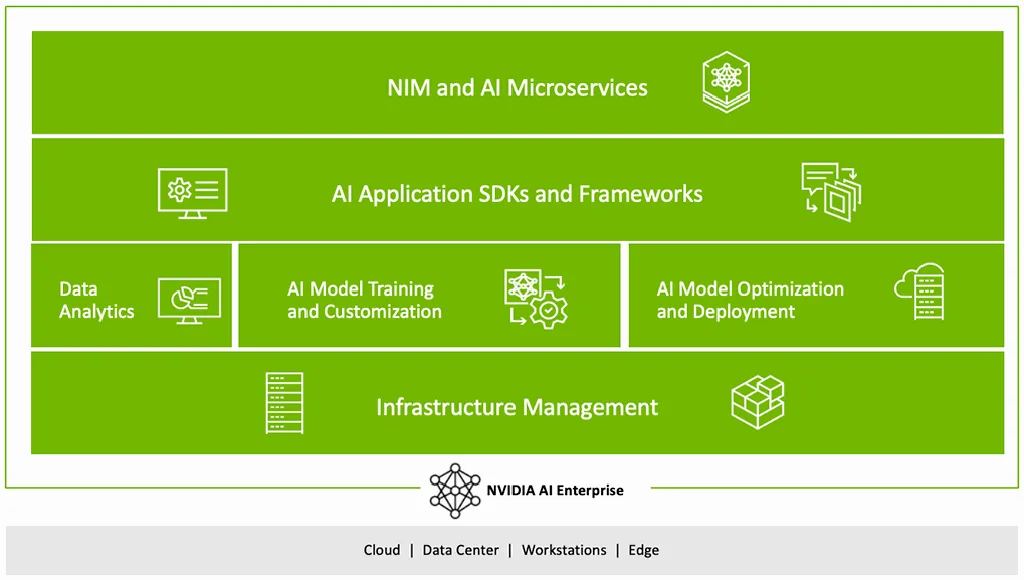
Plenty of organizations are already running LLMs (Large Language Models) in production today — chatbots answering questions from internal documents, assistants handling daily tasks. But a model that runs in a demo and a model serving dozens of concurrent users every day are two different problems. That’s exactly where LLMOps comes in.
What LLMOps Is
LLMOps stands for Large Language Model Operations — the practice of managing an LLM across its entire operational lifecycle. It builds on DevOps, MLOps, and platform engineering, but focuses specifically on what LLMs need: infrastructure, model-serving deployment, connecting data through RAG, performance tracking, version control, and security and cost management.
Put simply: if the LLM is the engine, LLMOps is everything that gets that engine running reliably, measurably, and cost-controlled, every single day.
Why Organizations Serious About AI Need It
Organizations that adopt LLMs without solid practices tend to hit the same set of problems:
- The system slows down or breaks under real load — smooth in the demo, breaks the moment concurrency climbs.
- GPU or API costs run higher than they should — spending grows and nobody can trace where it’s going.
- Internal data gets used without controls — sensitive information moves without a guardrail in place.
- No monitoring — problems show up with no way to trace the cause, so fixes become guesswork.
- Shipping a new model version is hard — every update takes manual work and risks breaking what’s already running.
- Answers aren’t accurate — internal data gets connected to the model without quality controls, so responses drift or get fabricated.
All of these trace back to one root cause: no system managing the model. Get LLMOps right from the start, and every problem above gets handled as part of the design, not fought after the fact.
What LLMOps Covers
1. Infrastructure
The foundation for running models in production — GPU servers, a Kubernetes platform, networking, and storage that scale with the workload. Organizations that want to keep data under their own control typically run models on their own infrastructure, which means designing from the hardware layer up through the platform layer.
2. Model deployment and serving
Exposing a model through an API applications can actually call — handling concurrency, autoscaling, and running multiple models at once. Common tooling here includes vLLM, KServe, and Ray Serve. The goal: fast, stable responses no matter how many users hit it concurrently.
3. RAG and data integration
Connecting the LLM to an organization’s own data — documents, manuals, knowledge bases. The result: the model answers from real organizational data, more accurately and with context that actually fits the business.
4. Monitoring and observability
Measuring both system and quality metrics — latency, throughput, token usage, error rate, GPU utilization, and response quality. Real numbers in hand mean faster fixes and improvements targeted at the right thing.
5. Security and governance
Access control, audit logging, data isolation between business units, and systematic secret management. The more internal data a model draws on to answer questions, the more this layer matters.
6. Cost optimization
Keeping spend under control — choosing serving architecture that fits the workload, allocating GPUs efficiently, using caching to cut redundant work, and matching workload placement to model size.
Where This Shows Up in Practice
An internal employee chatbot — employees ask about HR, IT support, or company policy and get an answer straight from internal documents. IT and HR teams see a real drop in repetitive support tickets.
A private LLM for sensitive data — finance or healthcare organizations with data constraints run an LLM on their own infrastructure. Data never leaves the organization, so AI gets used with real confidence around security.
RAG for searching large document sets — organizations with thousands of pages of documentation turn that into a search system that answers precisely, with source citations. Users ask in natural language and get a trustworthy answer, finding what they need noticeably faster.
Model serving as the backend for an AI assistant — model serving becomes the backend running an AI assistant or customer support bot continuously, handling many concurrent users with controlled latency.
Which Organizations Should Start With LLMOps?
LLMOps fits organizations preparing to use AI in day-to-day work, especially those that:
- Have tested an LLM and want to move it into production.
- Need to connect AI to internal organizational data.
- Want direct control over data, security, and cost.
- Plan to deploy models in cloud, on-premises, or hybrid environments.
- Have use cases involving chatbots, copilots, knowledge search, or document intelligence.
How LLMOps Differs From MLOps
MLOps manages the general machine learning lifecycle — data pipelines, experiment tracking, training pipelines, and model registries — suited to predictive models like sales forecasting or document classification.
LLMOps focuses specifically on the challenges unique to LLMs: prompt flow, token usage management, context handling, RAG pipelines, vector databases, and generative-AI governance.
In short: MLOps covers ML broadly, LLMOps goes deep on LLM-specific work. Organizations built around LLMs get practices designed for exactly that job.
How to Start With LLMOps
- Assess the use case you need to run in production.
- Choose an architecture that fits the workload and data requirements.
- Plan model serving, data integration, and RAG from the start.
- Prepare monitoring, security, and cost controls before production deployment.
- Design the platform to accommodate future growth.
For the related infrastructure foundations, read What Is an AI Factory? and What Is Kubernetes?.
Summary
LLMOps is the set of practices that turns an LLM from a demo toy into a system running in production every day — infrastructure, model serving, RAG, monitoring, and security through to cost control. Organizations that get this foundation right ship new AI features faster, run more stable systems, and keep budgets under real control.
Zotect provides LLMOps services covering model serving, deployment workflows, RAG integration, observability, and security. See LLMOps or get in touch.